THE ACT
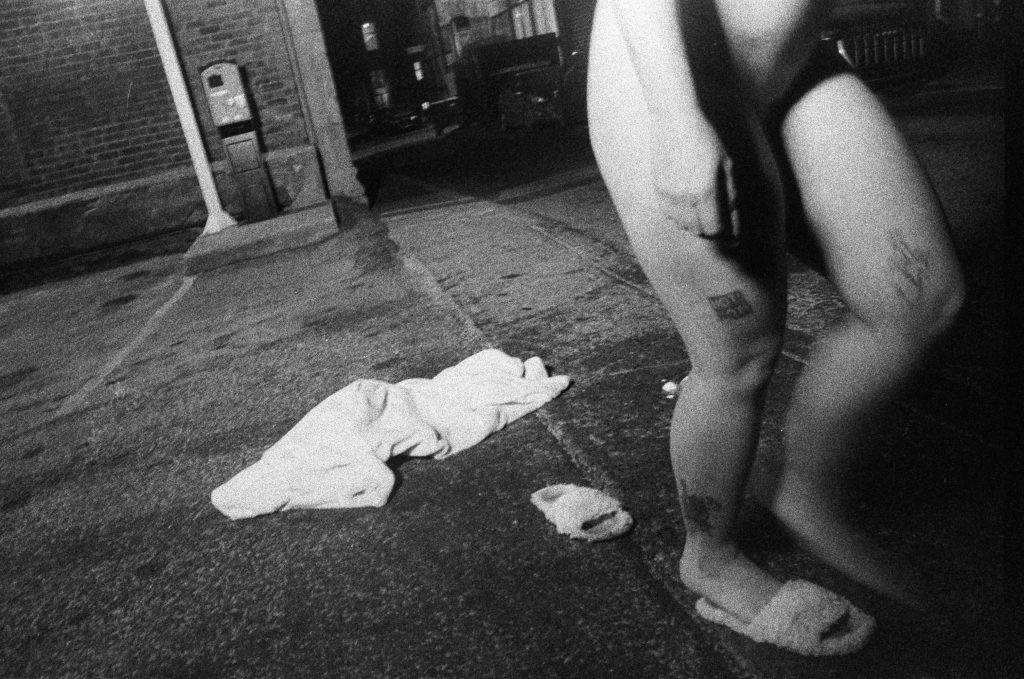
Victoria Arsenault, with whom I had collaborated on previously, photographed my performance conducted in November 2024 with the help of W3B104 (Silver’s Melody). We decided to shoot around 3/4am, in the Old Port of Montreal, in the financial district. It was zero degrees outside, and it even started to snow during the act. I walked naked, back and forth, next to the construction site of a high rise condo, on a terrain that used to be a publicly accessible park. Although I created this work some time ago, I’ve since felt compelled to revisit and contextualize it. I had to investigate why I wanted to create this imagery and expand my knowledge on space and the power it holds.
THE IDEA
While flying back from Italy, where I spent a few weeks sometimes working, sometimes wandering cities, meeting locals and visiting family, an image came to mind. Myself, naked, walking down an American city street. I tried to think about what this image could represent and why it came to mind.
INITIAL QUESTIONNING
What does it mean to be nude, in a public or urban setting? How does it feel, to be revealed and vulnerable?
Art and exhibitionism are, for some, intertwined. To reveal one’s art is like being naked in front of people, it involves exposure of beliefs, expression of soul. Upon having this idea, I wanted to analyze possible interpretations, to distance myself from my “exhibitionist” or any erotic tendencies and avoid sensationalism. Then I was confronted with my beliefs, around nudity. Why did I view it as inherently sexual?
The media is saturated with images of nude women, often times, sexualised and through a male gaze perspective. Because of western global conditioning, even if I attempt to deconstruct these notions, I can’t avoid the fact that they are very culturally charged. For this, I had to analyze my impulse towards self-exposure critically, which is the main reason why it took me so long to publish this project.
Other questions arose such as, what does it mean to feel watched and surveilled, upon stepping outside, in the public or as a female presenting person? How does it feel to wander the streets you once new and access old memories about the space, noticing the changing landscapes? How does space influence how we behave and internalize, understand the world? How does it feel to be, part of nature, yet, so disconnected from it, surrounded by skyscrapers and symbols of economic power?
Trying to understand personal symbolism behind this imagery, or action of walking naked, I wondered a few things.
Why to wander at night? Because it’s when my mind gains clarity and a more “bigger picture” view of the world. I feel like upon waking up, I’m more sensitive and closed off, immersed in my personal world and hyper aware about how I can be perceived in public or by others. At night, I can wander, just being, without thinking about how I’m seen, observing, as I have lived the day. Of course, this could be interpreted differently, another angle could be of how a woman wandering at night is a vulnerable state.
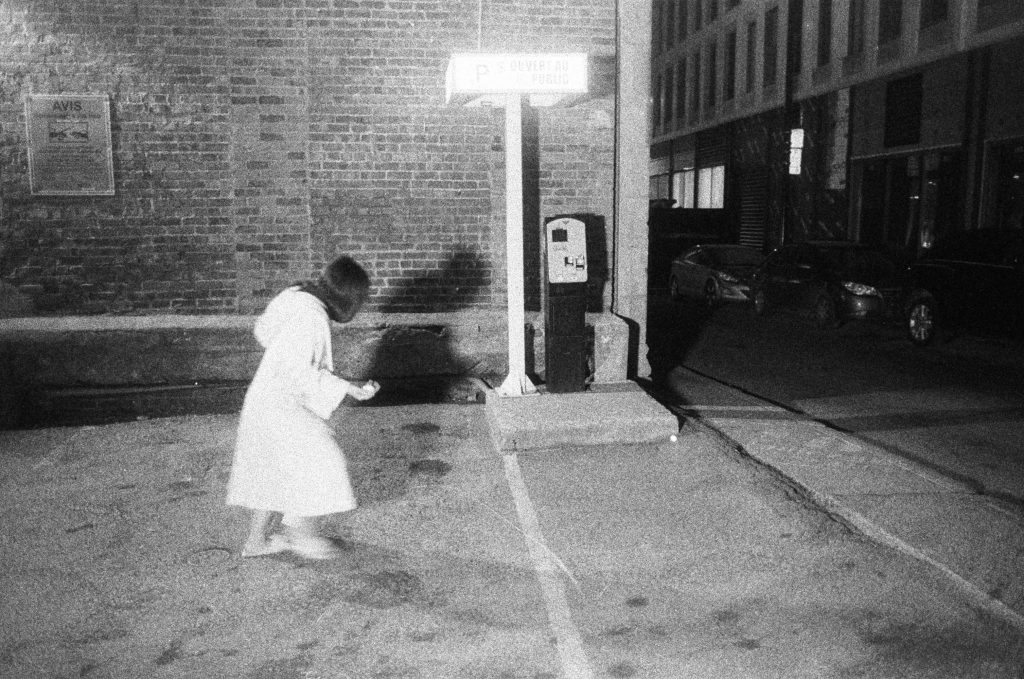
Why did this image pop into my head? And why was it important for me to think about possible interpretations so much before actually doing it? I guess the idea perplexed me, like after waking up from an odd dream. Wandering the streets at night can feel like dreaming, memories are sometimes more accessible through dreams as well. The details of someone’s face, a location visited in childhood, a lesson you forgot. Then this led me to think about sleepwalking, what would it have meant to go outside sleeping, the sensation of being half asleep, in a state awoken to symbolic interpretations.
I also thought about what it would mean to be naked, with images of this available publicly online. At first I was scared of showing my body, fearing the loss of control I could have over the pictures. I thought about it a little longer and thought, my body is meant to represent an idea in this context, it’s a natural element clashing with the urban landscape. As we’re in an age of digital hyper visibility, releasing the work would mean a certain loss of privacy online. With the rise of doxing practices and AI getting more realistic by the day, I thought, if I display my real body, or a modified one, how could someone possibly know? We are in a period of rapid technological progress, very different from when the web had initially appeared. Finding a community online today, involves more sophisticated algorithms, we have less control over our presence online. In this case, the body (mine) becomes a metaphor of data exposure. Our information is stored, traceable, tracked and sold to companies, we are watched. Maybe this vulnerability can be a response to this constant surveillance and monitoring, in the online world.
I needed to explain the imagery, to myself, and maybe to the public, maybe as a result of guilt felt at the idea of exposing myself. I needed to be honest about my personal experience with nudity, as the pervasive objectification of women’s bodies in visual culture, and my awareness of how kink shape perceptions of the body made it difficult for me to imagine how my own could be perceived outside a sexualized framework within the piece.
But I found it was an important investigation to make, on privacy, visibility in public space. John Berger wrote the following quote in Ways of Seing : “Men act and women appear. Men look at women. Women watch themselves being looked at. This determines not only most relations between men and women but also the relation of women to themselves. The surveyor of woman in herself is male: the surveyed is female. Thus she turns herself into an object of vision: a sight.”
The initial thought that there was something inherently shameful about me being naked, was too tied to how people could look at the work, or, me, in the work. I was literally watching myself being looked at, thinking about this performance. Doing it was a way to overcome watching myself and just being, concentrated on the physical sensations of being nude, my feet freezing from the 0 degree ground below me. I was in my body, just being. It was hard due to the cold, yet liberating to reclaim public space, confront shame, surveillance, and the gaze.
In wanting to avoid categorizing my body and its representations in the piece, I’m explaining different interpretations, resisting classifying my body’s representation into one specific meaning.
Massey’s book was central to my understanding of the philosophy of space, it explores what home means, in an urban and globalised context. Due to faster transportation and communication technologies, a concept known as space-time compression, humans are now moving a lot, in a period marked by seemingly endless trade and incessant media broadcasting.
This text is not intended to justify my piece, but rather to explore its possible meanings, interpretations, and the insights I have gained through my research on the theme of humans in space. Yes, maybe I should’ve just taken the photos and shared them without any explanation, but I felt it was important for me to dive deeper into the imagery. Engaging with Hume’s philosophy, I learned more about his beliefs on rationality, that our thoughts, and feelings come naturally to us, and we then try to justify them. Maybe that’s what I have done with this project, but it has been great to come to terms with the following; an idea doesn’t need to be explained rationally all the time, it’s okay to just feel without having to understand why. Although, as I’m sharing imagery of a naked woman, I thought about what it could mean on a larger scale, does it fuel collective imagery normalizing the appropriation of women’s bodies? Considering my perspective on this issue, and feelings during the performance, I would answer an obvious no to that. Nonetheless, for someone who just sees these images without any information, it could mean something completely different, even possibly seem degrading.
THEORETICAL FRAMEWORK
This project was inspired by Cindy Sherman, a photographer who staged herself to question women’s representation and how the gaze constructs identity. Space, place and gender by Doreen Massey mentions Sherman’s self photographs and the criticism they faced, using David Harvey, a Marxist geographer, as an example of a male gaze perspective : “(…) he was shocked to find that all these different images were of ‘the same woman’. It is an unintended admission, for that is precisely the effect they are supposed to have on the patriarchal viewer. Thus Owens (here she’s referencing Craig Owens, postmodern art critic and theorist) comments that they reflect back at the viewer his own desire (and the spectator posited by this work is invariably male) – specifically the masculine desire to fix the woman in a stable and stabilizing identity.” (Massey, p.238)
She sums it up as :“The argument is that we are living through a period (the precise dating is usually quite vague) of immense spatial upheaval, that this is an era of a new and powerful globalization, of instantaneous worldwide communication, of the break-up of what were once local coherencies, of a new and violent phase of ‘time-space compression’.” (Massey, p.156)
In the work, but also in real-life, the construction site I walk next to is a public parc, having been transformed into a high-rise condo in the financial district of my city. It’s a direct example of the changes in the world economy and value attributed to space. : “The changes even in the last twenty years have been enormous. They are characterized in a variety of ways: as a move from organized to disorganized capitalism, from modern to postmodern, from industrial to post-industrial, manufacturing to service, from Fordist to post-Fordist.“ (Massey, p.157)
Now as I’m analyzing the conceived notions of space, I want to relate my personal relation to space to what it historically has meant to women. I’ve often heard my grandmother tell me “not to go out at night” so that I wouldn’t experience the same dangers as she did, in the same metropolis, around half a decade ago. In this book, the author quotes Elizabeth Wilson who in her book, Sphinx in the City, analyses the notion of city culture, as one pertaining to men. “Yet within this context women present a threat, and in two ways. First there is the fact that in the metropolis we are freer, in spite of all the also-attendant dangers, to escape the rigidity of patriarchal social controls which can be so powerful in a smaller community. Second, and following from this, ‘women have fared especially badly in western visions of the metropolis because they have seemed to represent disorder. There is fear of the city as a realm of uncontrolled and chaotic sexual licence, and the rigid control of women in cities has been felt necessary to avert this danger’. ‘Woman represented feeling, sexuality and even chaos, man was rationality and control’.” (Massey, p.258)
Later on in the book she comes back to the topic :”Wilson writes of the way in which the big city – a ‘place’ which is by its very nature open and in flux – has produced in many a feeling of fear; fear of the disorder, the uncontrollable complexity, the chaos. But not all have felt this fear. Women, argues Wilson, have often appeared less daunted by city life than have men.“ (Massey, p.171)
Maybe that’s why, contrary to my grandmother, I feel invigorated walking in a city that feels like home, even at night.
Massey also parallels this to how, in literature,: “most male modernist writers of the early 20th century, and with the exception of Joyce – the dominant response to the burgeoning city was to see it as threatening, while modernist women writers (Woolf, Richardson) were more likely to exult in its energy and vitality. The male response was perhaps more ambiguous than this, but it was certainly a mixture of fascination and fear. There is an interesting parallel to be drawn here with the sense of panic in the midst of exhilaration which seems to have overtaken some writers at what they see as the ungraspable (and therefore unbearable) complexity of the post-modern age.“(Massey, p.258)
With the achievements of second-wave feminism, my (our?) city can be seen as a vessel for expression and perceived freedom, allowing me to enjoy public spaces and move through them. However, it’s important to recognize that not all bodies have the same liberty to wander, as I do in Montreal, whether in public or as a performance. This perspective is also rooted in a Western conception of feminism. Beyond that, I’m implicated in the phenomenon of space-time compression, as I have the privilege to travel and participate in this system, more so than many other women in less fortunate circumstances. Here’s an evocative passage from the book that illustrates how everyone is involved in this mechanism, albeit on different scales.
On page 149 of Space, place and gender, Massey states that :
“There are faxes, e-mail, film-distribution networks, financial flows and transactions. Look in closer and there are ships and trains, steam trains slogging laboriously up hills somewhere in Asia. Look in closer still and there are lorries and cars and buses, and on down further, somewhere in sub-Saharan Africa, there’s a woman – amongst many women – on foot, who still spends hours a day collecting water. Now, I want to make one simple point here, and that is about what one might call the power geometry of it all; the power geometry of time-space compression. For different social groups, and different individuals, are placed in very distinct ways in relation to these flows and interconnections. This point concerns not merely the issue of who moves and who doesn’t, although that is an important element of it; it is also about power in relation to the flows and the movement. Different social groups have distinct relationships to this anyway differentiated mobility: some people are more in charge of it than others; some initiate flows and movement, others don’t; some are more on the receiving-end of it than others; some are effectively imprisoned by it.
In a sense at the end of all the spectra are those who are both doing the moving and the communicating and who are in some way in a position of control in relation to it – the jet-setters, the ones sending and receiving the faxes and the e-mail, holding the international conference calls, the ones distributing the films, controlling the news, organizing the investments and the international currency transactions. These are the groups who are really in a sense in charge of time-space compression, who can really use it and turn it to advantage, whose power and influence it very definitely increases. On its more prosaic fringes this group probably includes a fair number of western academics and journalists – those, in other words, who write most about it.
But there are also groups who are also doing a lot of physical moving, but who are not ‘in charge’ of the process in the same way at all. The refugees from El Salvador or Guatemala and the undocumented migrant workers from Michoacán in Mexico, crowding into Tijuana to make a perhaps fatal dash for it across the border into the US to grab a chance of a new life. Here the experience of movement, and indeed of a confusing plurality of cultures, is very different. And there are those from India, Pakistan, Bangladesh, the Caribbean, who come half way round the world only to get held up in an interrogation room at Heathrow. Or – a different case again – there are those who are simply on the receiving end of time-space compression. The pensioner in a bed-sit in any inner city in this country, eating British working-class-style fish and chips from a Chinese take-away, watching a US film on a Japanese television; and not daring to go out after dark. And anyway the public transport’s been cut.
Or – one final example to illustrate a different kind of complexity – there are the people who live in the favelas of Rio, who know global football like the back of their hand, and have produced some of its players;who have contributed massively to global music, who gave us the samba and produced the lambada that everyone was dancing to last year in the clubs of Paris and London; and who have never, or hardly ever, been to downtown Rio. At one level they have been tremendous contributors to what we call time-space compression; and at another level they are imprisoned in it. This is, in other words, a highly complex social differentiation.
There are differences in the degree of movement and communication, but also in the degree of control and of initiation. The ways in which people are placed within ‘time-space compression’ are highly complicated and extremely varied.”
This lengthy excerpt explains thoroughly the implications of this phenomenon, and how mobility isn’t achieved everywhere, as some population groups are confined to a predetermined space. I invite you to think about what power you have over your mobility reading this following passage:
‘We need to ask, in other words, whether our relative mobility and power over mobility and communication entrenches the spatial imprisonment of others. But this way of thinking about time-space compression also returns us to the question of place and a sense of place. How, in the context of all these socially varied time-space changes do we think about ‘places’? In an era when, it is argued, ‘local communities’ seem to be increasingly broken up, when you can go abroad and find the same shops, the same music as at home, or eat your favourite foreign-holiday food at a restaurant down the road – and when everyone has a different experience of all this – how then do we think about ‘locality’?” (Massey, p.151)
What is locality, in the age of globalism, where cultural hegemony is no longer what it used to be? We are in a period of post internet culture and ‘local communities’ are even more broken up as they ever were. Not to mention the algorithms in place leading to the formation of digital communities shaped by tech giants political incentives.
Massey continues on what this new relation to the world means, that contributes, in my opinion, to the rise of populism : “None the less, it is certainly the case that there is indeed at the moment a recrudescence of some very problematical senses of place, from reactionary nationalisms, to competitive localisms, to introverted obsessions with ‘heritage’.” (Massey, p.151)
Here, Massey notes the problematic notions of place when it’s defined rigidly. She also also cites Laclau, in an argument where he explains that nothing is fixed, physical space is dislocated, meaning that representing it spatially is, an ideological, therefore non-neutral, act. He talks about temporality, and how movement, dislocation and change break the continuity in a space. In other words, any attempt to represent the world spatially is an attempt to ignore that dislocation, however, temporality breaks the continuity of the space.
Trying to tie these notions into the performance, we can consider it to be a revelation of this instability, for example how cities change due to gentrification, or how the “spatialized” idea of a woman’s body manifests itself when analyzing the piece. By walking during the change of seasons, fall into winter, I reintroduce temporality into an urban and capitalist space by engaging with my vulnerability, rejecting the idea that these depictions of space (through the photos) are stable and determined.
“First is that dislocation is the very form of temporality. And temporality must be conceived as the exact opposite of space. The “spatialization” of an event consists of eliminating its temporality’. The second and third dimensions of the relationship of dislocation take the logic further: ‘The second dimension is that dislocation [which, remember, is the antithesis of the spatial] is the very form of possibility’ and ‘The third dimension is that dislocation is the very form of freedom. Freedom is the absence of determination’. This leaves the realm of the spatial looking like unpromising territory for politics. It is lacking in dislocation, the very form of possibility (the form of temporality), which is also ‘the very form of freedom’. Within the spatial, there is only determination, and hence no possibility of freedom or of politics. (Massey, p.252-253)
In this discourse, Laclau explains that political change can emerge out of these public spaces when dislocated, through movement, here new possibilities can emerge.
Another philosopher of space, Lefebvre, shares the same general idea in the book Production of Space, writing that : “Physical space has no “reality” without the energy that is deployed within it.” (Lefebvre, p.13)
Now, if we look into other, more contemporary authors on the topic, bell hooks notes that the remembrance of space is, political, and different from nostalgia in Yearning, race, gender and cultural politics. ”Thinking again about space and location, I heard the statement “our struggle is also a struggle of memory against forgetting”; a politicization of memory that distinguishes nostalgia, that longing for something to be as once it was, a kind of useless act, from that remembering that serves to illuminate and transform the present.” (hooks, p.147)
Massey, citing bell, writes :”how, at times of estrangement and alienation, home is no longer just one place. It is locations. Home is that place which enables and promotes varied and everchanging perspectives, a place where one discovers new ways of seeing reality, frontiers of difference.” (Massey, p.171)
Through the act of walking naked through urban space, shaped by capitalism, and inscribed in a tradition of global flows of resources and capital, I’m adopting a global perspective, the space occupied is layered with histories of economic and social power. My presence participates in these structures, navigating globalized spaces, challenging social structures by the illegal act of public nudity. In walking at night, I’m recalling historical tensions around women’s freedom and vulnerability in urban spaces, my body becoming a site for interrogating representation, the gaze.
Performing this work within these frameworks transforms it from a private, personal gesture into a critical, political, and spatial inquiry. It interrogates how urban space, social norms, gendered bodies, and global flows intersect, making the personal political and the ephemeral site-specific experience a lens on larger structures.
The photographs of the performance can be seen here:
Key Sources
Hooks, Bell. Yearning: Race, Gender, and Cultural Politics. 0 ed., Routledge, 2014. https://thepoliticsofglobalart2018.wordpress.com/wp-content/uploads/2018/09/bell-hooks.pdf
Lefebvre, Henri, et al. The Production of Space. Blackwell, 1991. https://transnationaleverydaylife.wordpress.com/wp-content/uploads/2011/09/henri-lefebvre-the-production-of-space.pdf
Massey, Doreen. Space, Place, and Gender. NED-New edition, University of Minnesota Press, 1994. https://selforganizedseminar.wordpress.com/wp-content/uploads/2011/07/massey_space_place_gender.pdf