(Or Simulacra and Simulation)
“The simulacrum is never what hides the truth-it is truth that hides the fact that there is none. The simulacrum is true. -Ecclesiastes” (Baudrillard, p.8, 1981)
Reflections on Ways of Being
I read Ways of Being by James Bridle, in October, as I’ve been learning more about AI in my free time, mostly through YouTube, and I felt like the content I was watching was mostly about the impacts of these technologies, in the context of surveillance and control and around the ethical dilemmas we now face. I wanted to expand my knowledge and this book was a pleasant surprise as it not only was a refreshing take on my otherwise doomed conception of AI development, as I’m very concerned with its impact on global warming.
Ways of Being used a holistic approach towards intelligence, revisiting how us humans have defined it and categorized it, narrowing it down based on our umwelt. I learned lots about the behaviours of different species, such as how bees communicate and choose new possible living areas, or how animals have ways of communicating we’ll never fully understand, and the development of AI through history. I liked the philosophical approach, and learning about the effects of chance, and how this principle can be used in methods and algorithms, such as the Monte Carlo effect. Randomness has a lot to do with our world and how we came to be, and how, this may not be the most effective way of gathering data, yet it lets us see options and arrangements in a disorganised manner which gives more room for chance. Why am I saying all this? Because lately I’ve been researching the impacts of space-time acceleration, a phenomenon also known as “compression”. I’m interested in this as it has affected me personally, letting me travel, be “connected” with global news, and friends and family from different countries. Digital technologies play an immense role in our personal lives, impacting our decision making, hence, I think this enhances the “butterfly effect”. I think this phenomenon has created an immense sentiment of generalized anxiety in the western world, or the global north, as it has confused our notion of the present. For example, I’m seated in my room writing, yet I could call my mom, and suddenly share the same emotional space. Simultaneously, I can open my ipad, and read the news, all the while opening my laptop to write down ideas for my next project, that will come to fruition because of the work of programmers in the last century, the acceleration of transportation, which lead me to Scotland as well as the imperialistic, historically colonial exploitation that lead me to be able to have all these appliances accessible to me at a “reasonable” cost considering I am from a country with a good GDP because of resource extraction and Indigenous dispossession (Oh Canada).
Space-time compression occurs as technological innovations occur exponentially, condensing temporal distances, shrinking effective distances between places. This includes technologies of communication and mass media. It’s a concept with roots in postmodernism, marxism and directly linked to globalization. On an individual scale, this leads humans to feel like the world is smaller, faster, and less anchored. I added Simulacra and Simulation to the title of this Leaning Journal, as this theory, invented by Baudrillard, captures the cultural consequences of the aforementioned phenomenon, as accelerated communication, mediated images and collapsing distances replace lived experience with representations and individuals are increasingly interacting with hyperreal images rather than material realities.
Getting Started
Before starting, as I come from a more video based background, I wanted to familiarise myself with P5 and know how to use Visual Code. Looking through the P5 tutorials on their website, I familiarised myself with the javascript coding language. The first exercise I did was one where I created an element, a circle, and could change its color once the mouse was pressed. This was a nice refresher on how to change colors and the shapes that were possible. I then added a function where I could automate the visuals, incorporating the frame rate variable.

Next, I played around a bit more with the shapes and colors, creating a drawing where I incorporated emojis. I didn’t have a goal in mind when doing these exercises, except for familiarizing myself with the softwares we would use in class.
I then tried a youtube tutorial that uses image capture, to take photos using different filter effects, imported as png’s into the sketch. I was about halfway through, although i had to stop the project as I didn’t understand what I was doing. I then looked into my code and noticed that I was unable to load the images through the path I had copied them from. I decided to stop there and wait till the first class.
Reflections during and after the project launch
During the project launch, Cat mentioned many different artists that I wanted to research more as they had thoroughly analysed contemporary themes.
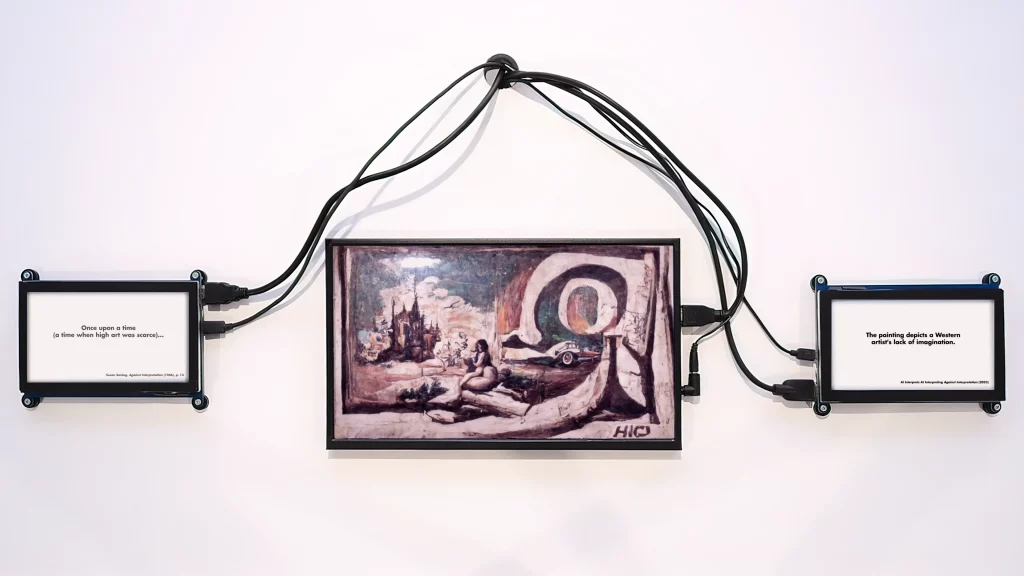
Looking into Jake Elwes’ work, I found it to be very compelling and visually pleasing, and it felt accessible to many, as it spoke on many contemporary experiences everyone faces, such as representing what doomscrolling feels like for extended periods of time. I was especially intrigued by A.I. Interprets A.I. Interpreting ‘Against Interpretation’ (Sontag 1966), as it speaks to our fascination of infinity, here images are constantly created anew by AI, using art-related prompts.

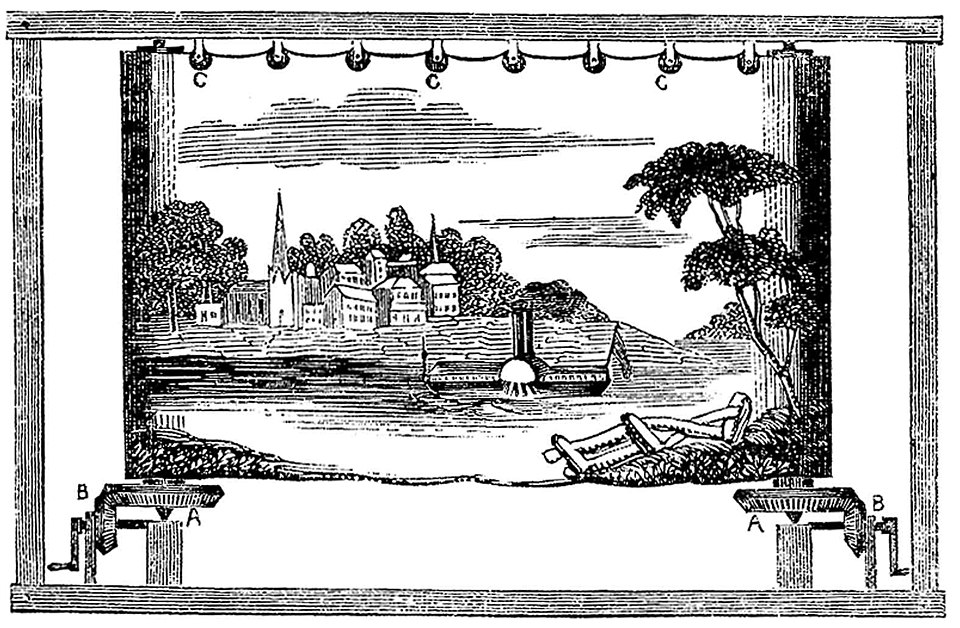
Fascinating to see what AI would create, and then criticism or comments it would suggest, that felt a bit humorous as they mimic what humans tend to think or say in museums. It reminded me of a talk I attended at my home university, Concordia, where David Rokeby presented his VoiceScroll, a real-time voice-to-panoramic image generator. I love art that lets viewers learn about history, in this case, winking at the panoramic painting, which was an immersive viewing experience, the first of its kind, appearing in the 19th century, linking that invention to our fascination for everything AI nowadays (I’m generalizing but you get the picture).
These works circle back to the role of randomness, and how much of what we encounter, both in technology and daily life, is shaped by chance. Even algorithms, which appear to operate through strict, linear logic, contain elements of unpredictability, whether through probabilistic processes or the unforeseen ways their outputs circulate socially. I’ve been thinking about how this mirrors my own position as a relatively comfortable student: the opportunities available to me, but also the unintended repercussions of my decisions. Something as simple as purchasing a new laptop participates in a global supply chain, supporting corporations like Microsoft or Apple, while a short trip to another European country has environmental and social consequences. As western users of technology, we often overlook these downstream effects, mesmerized by the abundance of possibilities and information we have access to. AI serves as a metaphor for this; the possibilities of representation and progress are infinite, or, unknown. Currently, there’s a “hype” about this, reflecting how fascinated we are as a species with limitlessness. To me this fascination with digital possibility can serve as an entry point for thinking about sustainability, ethical responsibility and the pressures of choice anxiety. Ultimately, I think AI is the zenith of the phenomenon of space-time compression, and my art work in this project could serve to;
- Explain the phenomenon, relating it to the viewer’s experience.
- Serve to bring awareness to the blind spots of “endless progress”, and highlight how data is collected when we engage with technologies such as AI.
- Help the viewer recognize how the anxiety they may be tied to a larger systemic accelerations, hopefully alleviating symptoms of distress.
Lately, I have felt a bit disorganised and out of touch with my sensibilities. For some reason, naming my emotions became something I was avoiding, I’d much rather numb whatever I was feeling, distracting myself with the multitudes of various forms of entertainment available to me. I remember a high school teacher telling us that we should never be bored as we have such accessible entertainment nowadays. So I decided : I’ll never be bored and it’s important I stay informed. But by wanting to stay “up to date” with current affairs, my experience of reality became distorted, as I was seeing places that I had never been to in real life and situations that I couldn’t prove happened. Another layer is added to this, as fake AI generated content has become indistinguishable from the real, from reels to music on spotify. Contemporary technologies alter our experience of reality, space time compression does this through speed and distance, and Simulacra and Simulation does this through representation and meaning.
“Today abstraction is no longer that of the map, the double, the mirror, or the concept. Simulation is no longer that of a territory, a referential being, or a substance. It is the generation by models of a real without origin or reality: a hyperreal.” (Baudrillard, , 1981, p.8)
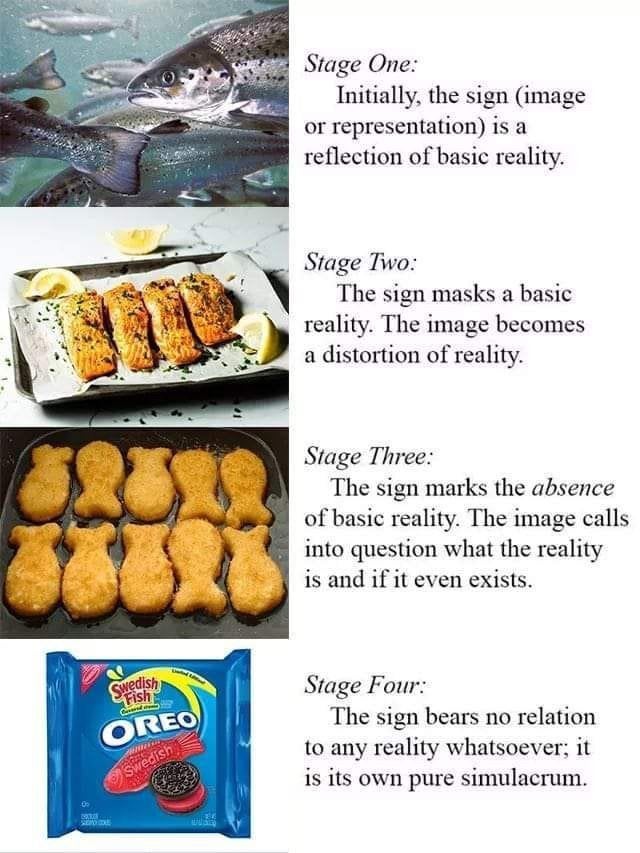
Open Sky by Paul Virilio deeply inspired this project. The media is saturated with images, and as an image producer, I need to be more careful of the symbolism used behind the simulacras I create. Furthermore, I think my eco-anxiety makes me refrain from using certain softwares on an ethical standpoint. I’m reluctant to use technologies from companies that are driving us to extinction for profit, as well as societal control, such as Google. For example, Google renamed the Gulf of Mexico; Gulf of America, aligning with Western geopolitical interests and erasing history. We could call this digital neocolonialism. Thinking about the VoiceScroll, we can mention how certain words could favour representations of the dominant narratives and images we see. For example, if someone says any job titles, the VoiceScroll might visualise a very biased depiction of this, in terms of gender and race. So using AI, and prebuilt datasets, even if I am training my machine to be ethical, using Google to do this would go against my values and concerns me ethically.
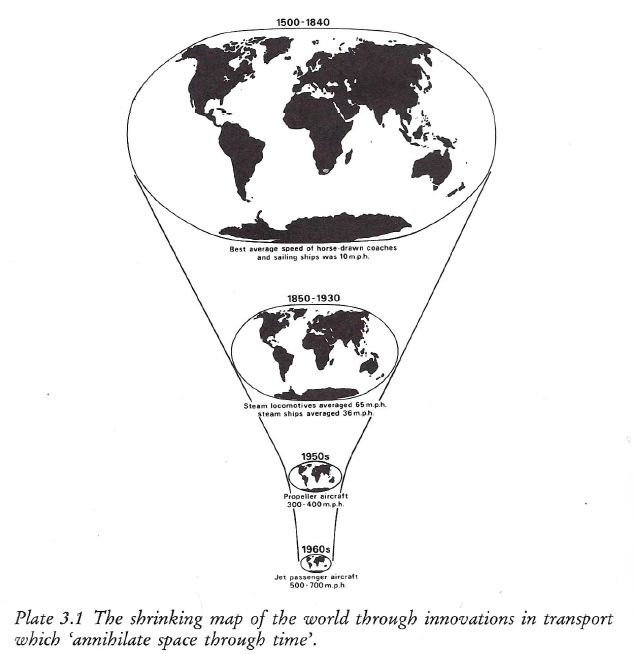
I decided to settle on a project relating to the theme of space-time compression, as it has been fascinating to me.
I thought about creating something that would let the viewer question their participation, maybe creating an effect similar to Elwe’s work, in which I would like it to be humourous, referencing digital media culture, and to disconcert the viewer, alluding to how surveillance is present in our daily technologies sometimes disguised behind a semblance of entertainment.
Workshop 1
I brought a few objects to class, such as a hat, a mug and a hairclip. I had issues opening the files in the first place but got around it with a bit of patience. I think I would like to use the facemesh into my project, as I found the image detection to be a bit too inaccurate in its recognition, for my liking. I understand, however, that this is because we did the machine learning fairly quickly in class, therefore, I might still try to do this if I have more time to play with image recognition with a clear goal in mind when training the model.
Workshop 2 and 3
I was unable to attend these, therefore, I familiarised myself with the workshops from last year. In the first one, I was able to try processing for the first time, and use the webcam, although I wasn’t able to figure out how to recognize objects in the background. By the time I finished this workshop, the new ones from the Friday class were out so I watched them to get an idea of what’s possible with machine learning.
Conception
My idea, loosely inspired by Hieronymus Bosch’s visual density in the Garden of Earthly Delights, is to create an interactive image that reacts to the viewer’s physical proximity. From a distance, like 2 meters, the viewer sees a complete, cohesive picture. Naturally, they will want to step closer to inspect the details. But as they approach, a proximity sensor triggers the image to zoom in, revealing hidden images embedded within the original picture. Instead of gaining clarity by moving closer, the viewer is pulled deeper into a layered visual world.
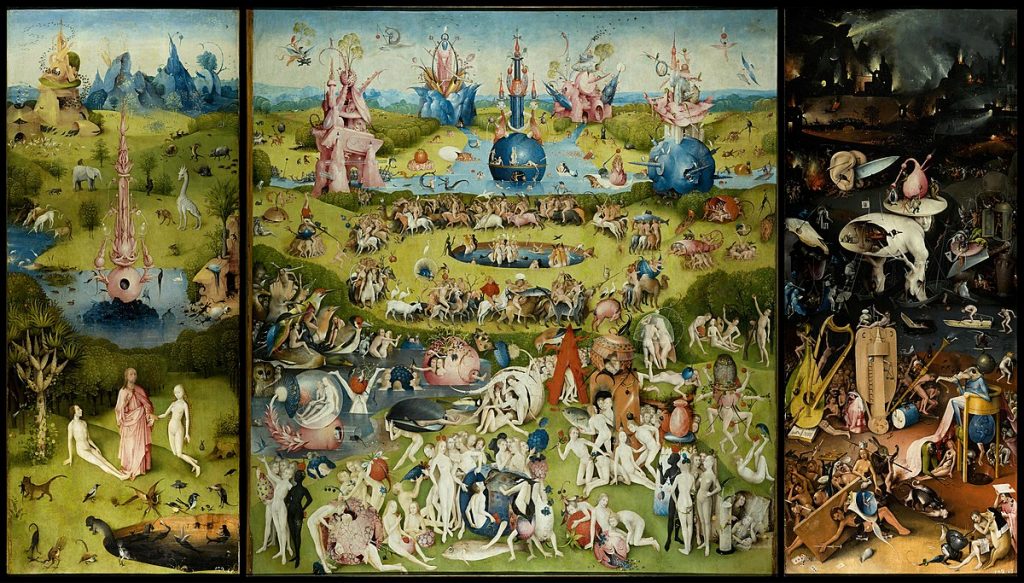
Bosch’s religious beliefs are unknown, but interpretations of the work typically assume it is a warning against the perils of temptation. I decided to inspire myself from this work as it is visually beautiful and grandiose, in its scale, mesmerising the viewer just like AI is seen as a means to infinite possibilities. Here, heaven, hell and earth coexist in one work. I’m not intending to reference religious beliefs in my work, I just think it’s interesting to reflect on, making parallels to; how AI can be used for good, respecting the umwelt of earthly species, how the climate crisis is affecting different parts of the world and what the world looked like before the industrial revolution. Bosch’s garden of earthly delights also mirrors how we experience overwhelming modern systems and feel as though everything is happening at once, everywhere. It’s also the kind of work you need to get closer to understand what exactly is happening, this way the viewer can get lost in the multiple layers of meaning and experience.

Part 2
The actual making of the thing…
I decided to use the facemesh function and looked at a Coding Train video to see what was possible.
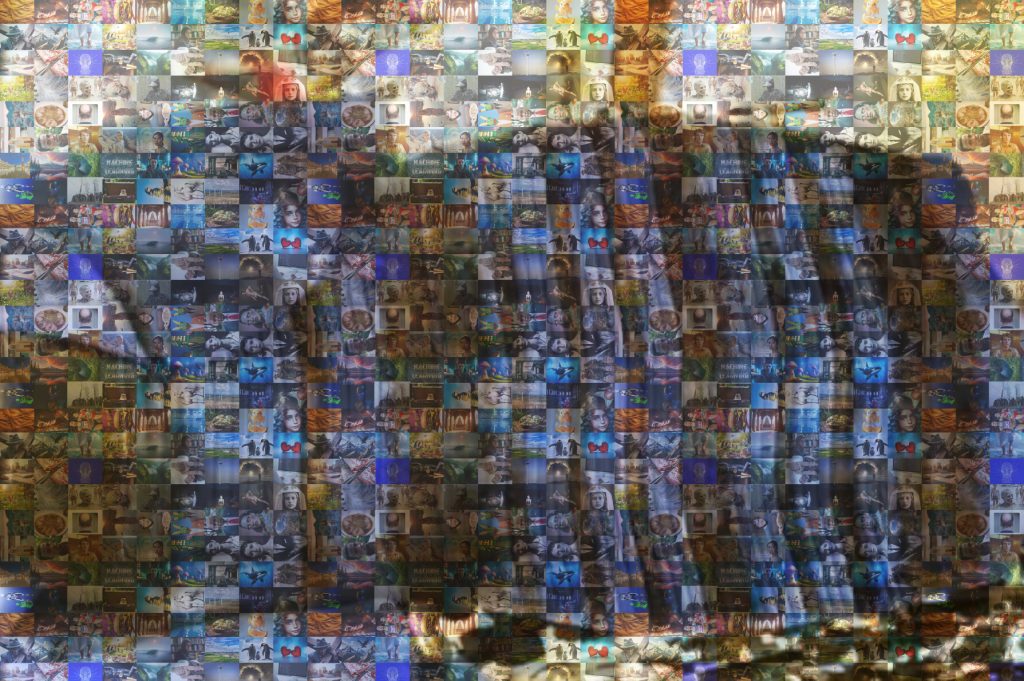
Here’s an explanation of the installation, as I imagine it. The viewer(s) enter(s) a room. They see a projection on the wall of the blue and black or white and gold dress, the viral internet phenomenon from 2015 that revealed differences in the way we perceive colors. Once the camera detects a face, the image lightens and a mosaic of hyperreal ai images appear. The center point of the face detected is used as a guide to zoom into the mosaic and let the viewer inspect the images. For now, when the webcam detects 2 faces, this quote on space time compression by Virilio shows up.
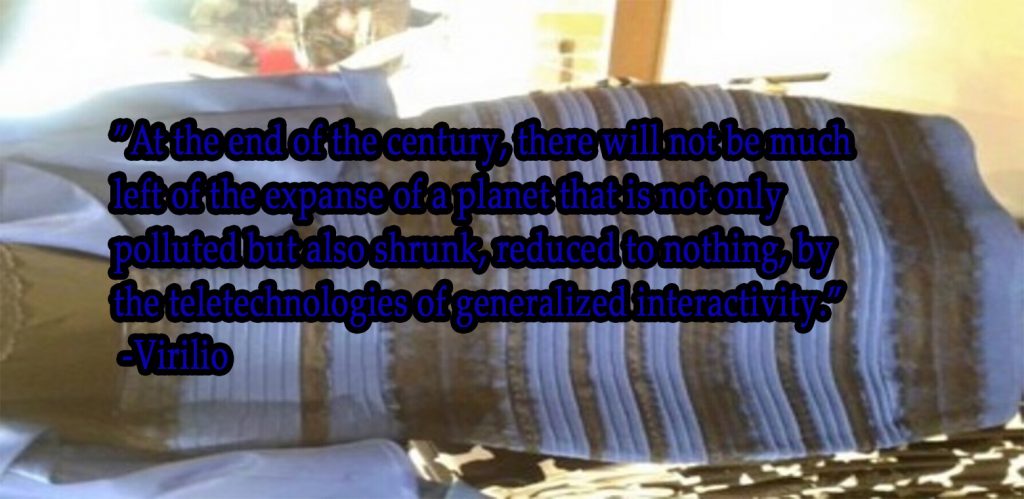
The project is still an unfinished prototype, as I’d like this quote to appear if the facemesh detects a “surprised” face (the mouth is open). Other quotes could appear with other trained facial expressions, such as “confusion” (eyebrows come closer), and “concern” (eyebrows raised). However, because of issues with coding and time constraints, I wasn’t able to fully implement this idea and decided to go with the number of faces instead. With the help of Cat, I was able to zoom into the mosaic based on the key points I had for the face. For this, I chose to create a rectangle around the face and highlight the middle with the red dot to estimate the value of the center and its smoothness. I then created the image using photoshop, as I realized I wouldn’t have the time to program an overlay effect using blendmode in the code, based on my level of experience. I had a few issues with the sizing of the canvas and the webcam as well, that’s something I’d like to work on further for the final prototype. The code is available through this link :
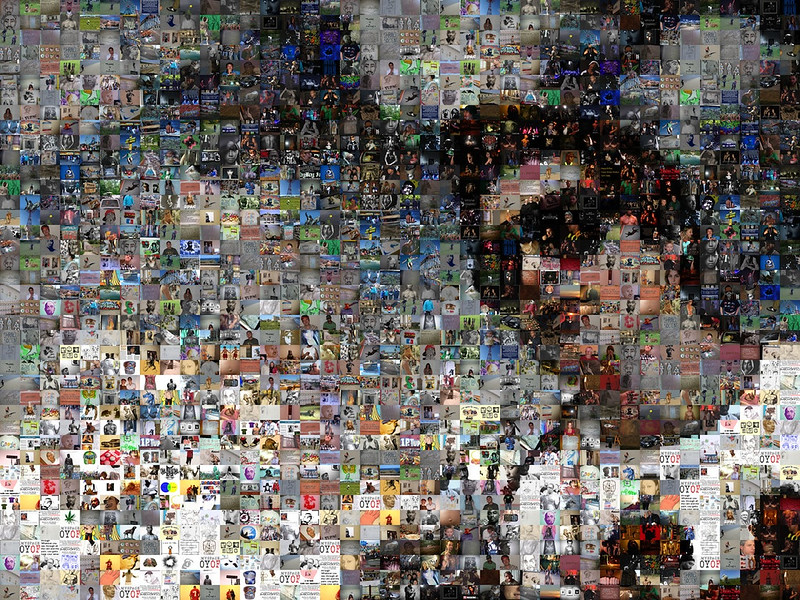
I created a mosaic using AI images that caught my eye, either because they seemed real or they evoqued something, some by the textures, others because they were amusing. In the future, I’d use an ai hyppereal only image database, and ideally, use a grid function to place each image inside. Realistically, I think the most efficient way to relate this idea to an audience would be through the handpose function. Upon listening to my classmates’ presentations, I noticed it was more engaging and the “facial data” wasn’t a central theme to my ideas. I think I’d be better off coding different functions for hand gestures. For example, a user could “grab” an image to move around the mosaic, that could include somewhere around a thousand images + so there’s a feeling of “immenseness” or infinity.

Now on the images themselves, the dress image is real, but seems like an illusion, whereas, the images underneath are all illusions (except for 1 real image of ecological disaster : contaminated water). In the future, if I would expand this prototype, all the images underneath would be hyperrealistically generated to push the viewers image deciphering skills further.
The images were sourced from @tinap.ai and @komopop on instagram, as well as reddit, pixabay and Pinterest. I didn’t want to generate my own images because that would be against the project’s thesis: we have created enough images and it’s increasingly hard to decipher the real from the fake. I’ve also done that in a previous project: (DICE), and I found it to be very time consuming, in regards to the value added to the project, not to mention the energy making these images consumes. Ideally, I’d collage these underlying images better, so they can make sense with the image layered on top.
Unfortunately, because of the short deadline for this project, as well as the cold I got that impacted my energy level caused me to be a bit behind. I think the project is theoretically sound, but there are more things that could be added to the sketch to increase interactivity and incorporate machine learning a little more.
Another idea came to mind, adding a physical element to the piece. I thought about optical illusions, and red and blue 3D glasses, like those from the movies, or that you wear to see a solar eclipse. It would be interesting to use these, to encourage the “1 viewer at a time” constraint, and enforce the idea of the spectacle, or the aforementioned panorama. Once the glasses would be detected, an audio could be cued to incite the user to wear them, and then another hidden layer to the images would be revealed to them, such as a quote on the hyperreal or something like “Nothing you see here is real”.
References
Baudrillard, Jean. Simulacres et Simulation. Éditions Galilée, 1981.
Virilio, Paul. Open Sky. Translated by Julie Rose, Verso, 1997.
“The Dress.” Wikipedia, 13 Nov. 2025. Wikipedia, https://en.wikipedia.org/w/index.php?title=The_dress&oldid=1321944304.